As one crosses the DND Flyway from Delhi to Noida, it is difficult to miss the mucky and shallow waters of river Yamuna, India’s fifth largest and most polluted river. Industrial pollution, uncontrolled flow of untreated sewage, dumping of solid wastes, sand mining have all contributed to the destruction of the ecological balance of this river with all its water quality parameters way above the prescribed safe limits.
Seeing the river in such a piteous state, it is difficult to imagine that long before it gets defiled by humans, its waters have a crystal clear purity and freshness at Yamunotri where the river originates high up in the mountains covered with snow and lush green forests. It is difficult to believe that this polluted river also has immense religious and mythological significance as a Goddess among Hindus, many of whom undertake the long journey to reach the shrine of Yamunotri dedicated to Goddess Yamuna. The Char Dham Yatra in the state of Uttarakhand is a pilgrimage to the four holy shrines of Yamunotri, Gangotri, Kedarnath and Badrinath located in the high altitudes of Garhwal Himalayas. Every year this pilgrimage tour brings in millions of devotees and travellers to the state during the summer months from April/May – October/November. The Yamunotri temple is typically the first shrine visited by devotees on this pilgrimage.
I visited Yamunotri on a whim. In the month of May, I was travelling in Uttarakhand and arrived one evening in Uttarkashi to go on an unplanned trek. Uttarkashi is home to the famous Nehru Institute of Mountaineering and is the base camp for some very popular treks in Uttarakhand such as Dodital, Dayara Bugyal, Gaumukh-Tapovan and others. It is also a stopover for travellers going to Gangotri and Yamunotri. My unplanned trekking plan didn’t work out. So next morning at 9.30 am I went to the bus stand looking for a bus to Dehradun when I saw a bus waiting to depart at 10.45 am for Yamunotri. Going back was a depressing thought and a journey to Yamunotri had the potential to satisfy my initial desire to travel and trek in the mountains. So just like that I went to the counter and bought a ticket to Yamunotri instead of Dehradun.
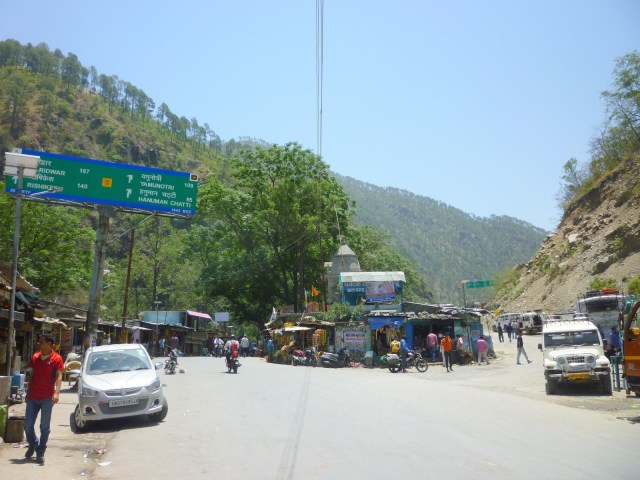
Waiting at Dharasu bend
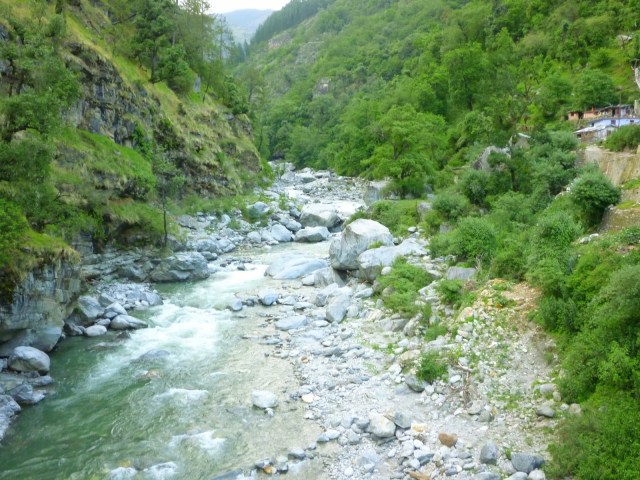
I called my mother to inform her about my changed plan. At 10.30, I boarded the bus and duly occupied a window seat in the back. The bus started on time and so we were on our 125 km journey on uneven winding roads passing through towns such as Dharasu, Barkot, Syanachatti and Hanumanchatti. The buses don’t actually go all the way to Yamunotri and instead stop at Janki Chatti from where one has to trek 5 – 6 kms to reach the shrine. Due to the narrow roads damaged at some places and the peak pilgrimage season, buses go on an average speed of 25 km per hour and stop several times to allow the traffic to pass from the other side. Although we were travelling quite high in the mountains, during the initial few hours of the journey the weather felt as hot and dusty as in the plains. Combine that with travelling in a bus whose seat cushions had hardly any foam left in them and whose parts down to the screws and bolts were just about holding together, and what you have is a journey where you don’t feel your butt after a while and question your own sanity for coming on this trip in the first place. My mood got better during the last couple of hours when the snow covered mountain range came into view along with the fresh and vibrant waters of Yamuna flowing through the forested valley. It was a delight to see the Yamuna in such a healthy state for the first time.
First view of the Yamuna in a healthy state
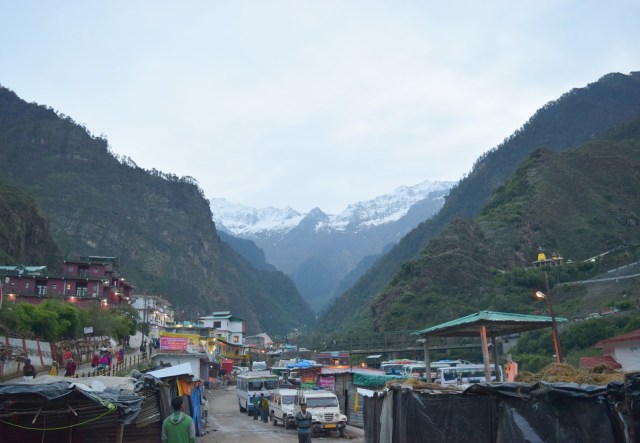
The bus reached Jankichatti at 7.15 pm by when the light had faded. I could hear the river gushing in full flow. Jankichatti is basically a base camp area where there is nothing else except a number of hotels, guest houses and small restaurants, all catering to devotees and travellers coming to visit Yamunotri. There is a big parking space for buses and cars. It was all very crowded during this peak season. Hordes of new devotees were arriving by buses. Many were coming back from their trek to the temple and returning by private cars and taxis.
At Jankichatti
I got a room in Hotel Shubham Palace for Rs 1100 (peak season price) and had nothing to do but rest after the long journey. I had a vegetable thali for dinner in the hotel’s restaurant during which I chatted with the owner about how the business of the hotels, restaurants etc. based on the Yamunotri temple exists only for six months. The Yamunotri temple opens every year on the auspicious date of Akshaya Tritiya in April/May and closes the day after the festival of Deepavali in October/November. Everything shuts down during winter and not a single soul is around with Jankichatti covered with several feet of snow. The owner advised me to start early in the morning by 4 – 5 am as it gets very crowded on the trek later in the day.
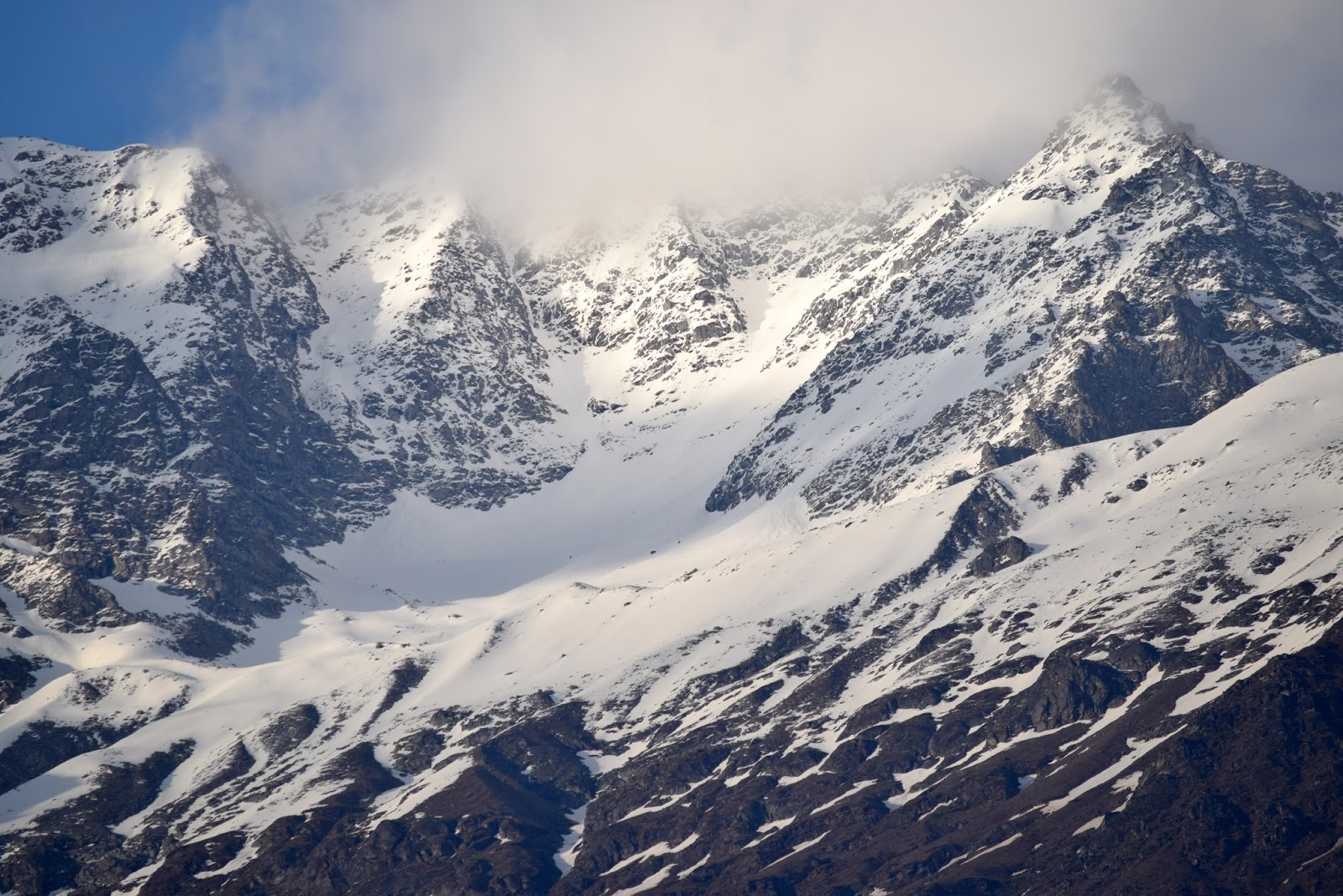
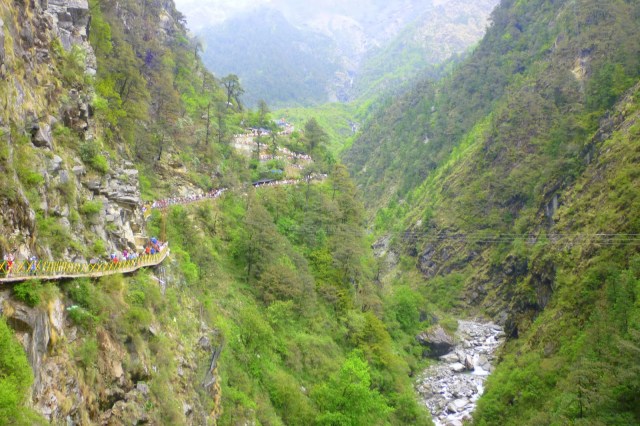
I retired for the night setting an alarm at 4.30 am. Next morning I got ready and started my trek at 5 am. The trek path starts from near the parking bay. Since Yamunotri receives millions of visitors every year, the 6 km trek is on a well paved cemented path protected by iron railings with several rest stops and shops selling tea and snacks. The whole trek is in the picturesque view of the snow capped Banderpoonch peak and the tranquil clear waters of Yamuna flowing in the valley.
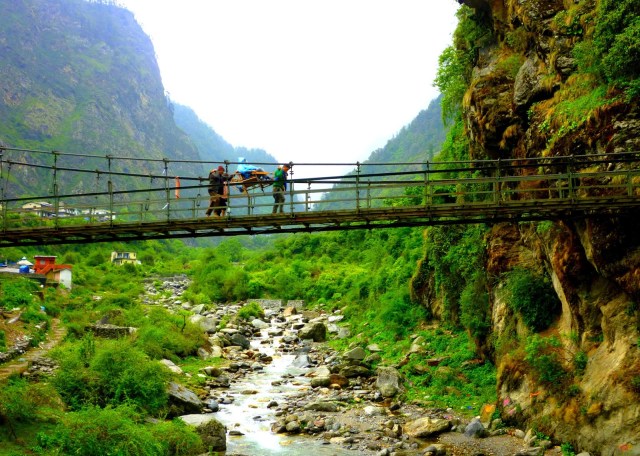
A pilgrim carried in a palki on the trek
The serpentine trek route to Yamunotri
At the start, touts approach you to take you up on a mule. Mules, Palki and Kandi are the three modes of transport for the elderly and those who are either unable or unwilling to walk the steep uphill climb. The palki, like a palanquin, is basically a small chair fixed within a wooden frame with support on either side carried by four people. Kandi is a big basket fixed with a seat which is carried by one person. I can somehow understand the aged and infirm who are physically incapable to walk the steep climb. I am however, repulsed by able-bodied men, women and teenagers doing their pilgrimage riding on mules or shoulders of other people. A person carrying another 70 kg person on his shoulders on a 10 km up-down trip is nothing short of torturous slavery in the name of providing livelihood. It is better to not go If you can’t walk. It drizzles frequently in the afternoon and at night so the path was all muddy and filthy with substantial quantities of horse dung added in. Walking on the muddy path full of dung and crowded with humans, mules, palkis and kandiswas just very messy.Any irritation is however compensated by the magnificent mountain atmosphere around you filled with prayers and spiritual sentiments of pilgrims who have traveled long distances to reach here. All along the trek, devotees keep singing prayers of goddesses Yamuna and Ganga. I met a sadhu on the way who told me about Saptarshi Kund which is further 10 km up the Yamunotri temple from where the origin glacier can be seen. The Yamuna arises from the Champasar Glacier at an altitude of 4421 m near the Kalindi peak of the Banderpoonch massif. The glacier is not very accessible so the temple has been constructed at a lower altitude of 3293 m. As per the sadhu if one takes the Yamuna water from Saptarshi Kund, carries it safely to the Rameswaram temple in Southern India and pours it over the Shivalinga there, then he or she was bound to attain moksha.
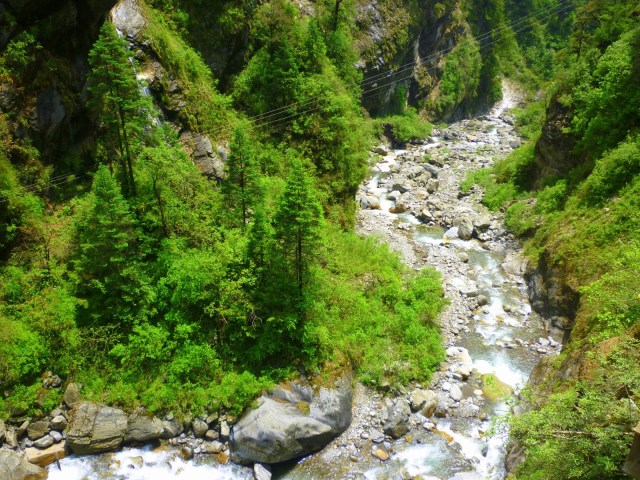
View of Yamuna during the trek
A pilgrim carried in a Kandi on the trek
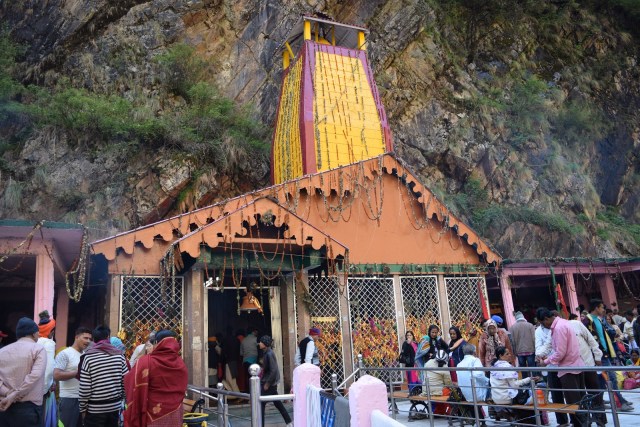
It took me three hours to reach the temple. The path near the entry to the temple was lined by eating joints and shops selling religious items. Inside the temple premises, there is a kund or well which receives hot water from an underground hot spring. Most devotees take a dip in this hot spring before going to the main temple. I too took a dip in the water which was too hot for my comfort. Even after twenty minutes or so, my body didn’t get used to its temperature and I couldn’t fathom how others were taking full underwater dips not one but several times. Maybe I was not pure or pious enough. I quickly got out, changed and moved to the main temple.
Yamunotri Temple
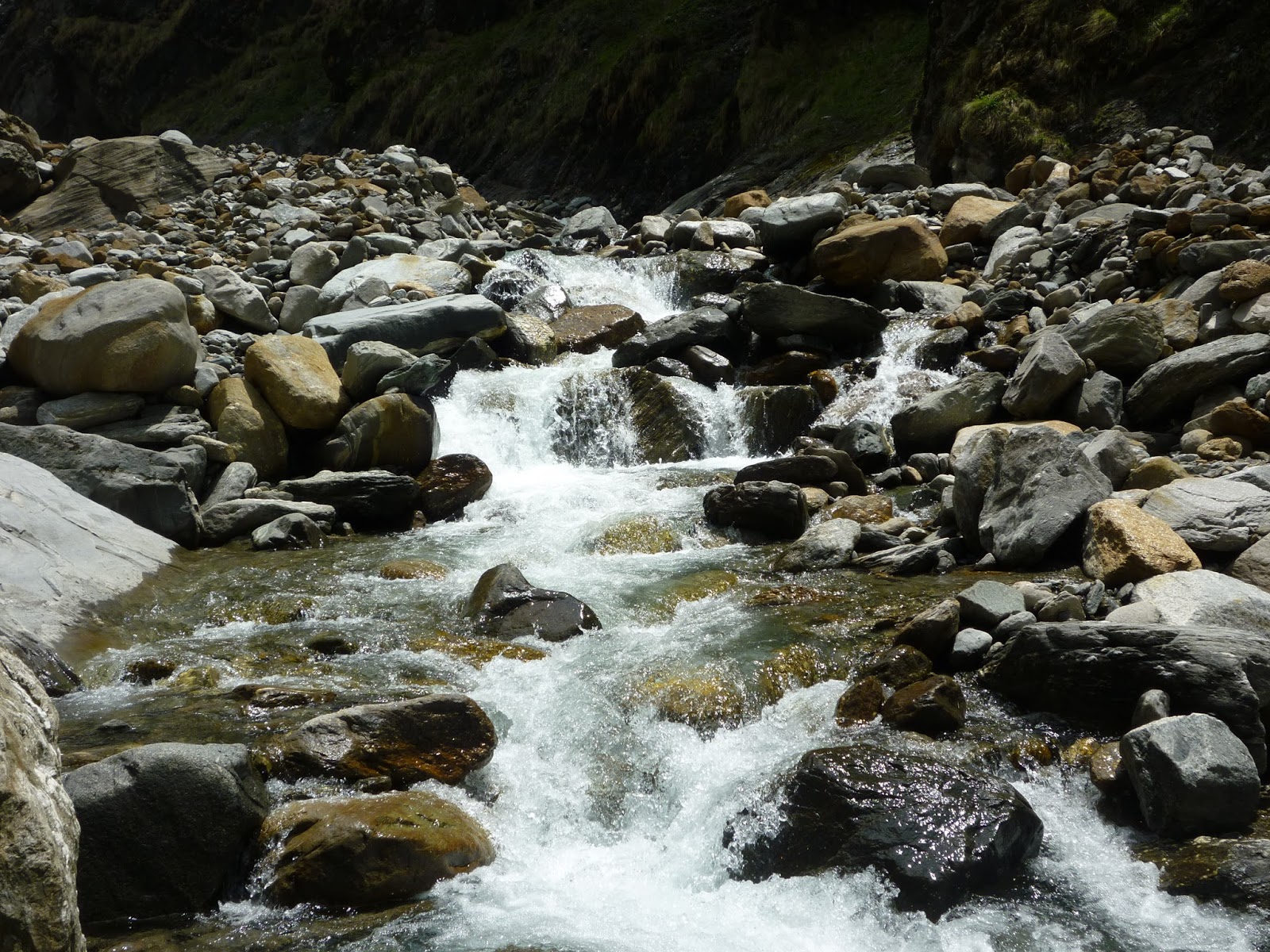
The vibrant Yamuna at Yamunotri
The temple has been damaged by flood and landslides quite a few times and the present structure of the temple was built by Maharani Guleria of Jaipur in the 19thcentury. Inside the sanctum the bigger idol of Goddess Yamuna made of black marble sits alongside the smaller white idol of Goddess Ganga. There is another kund (hot spring) near the temple called Surya Kund whose water is too hot for bathing. An interesting ritual among devotees is to dip small bundles of rice, potatoes and flour into this kund. The extremely hot water boils the rice or potatoes within few seconds which the devotees then consume as a prasad.
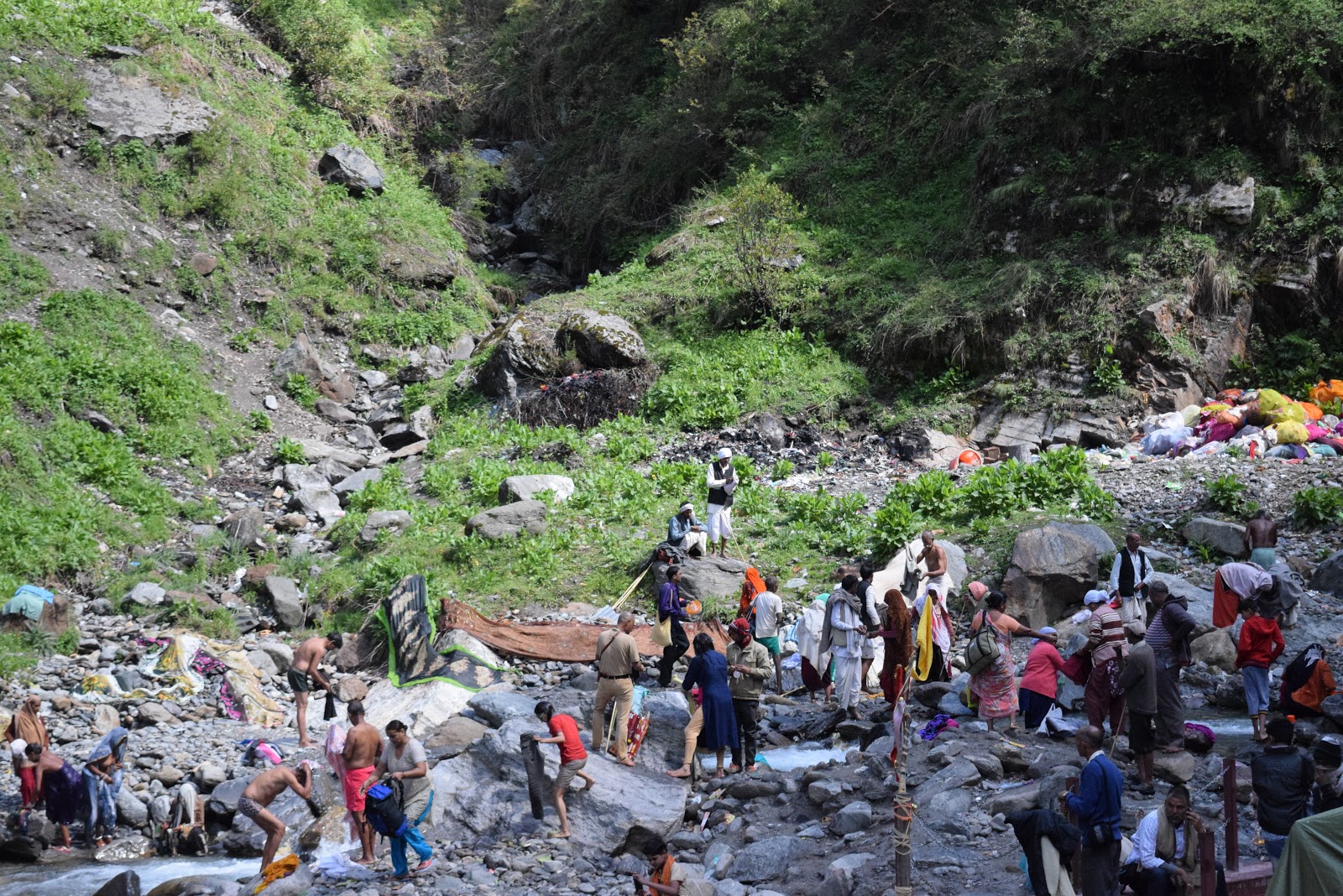
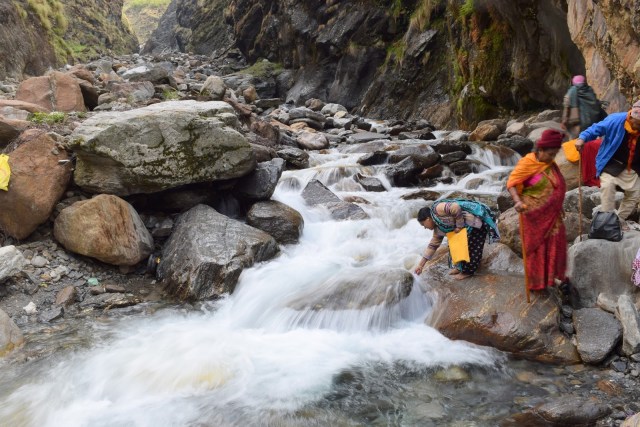
The temple is surrounded by high mountains covered with thick forests. The Yamuna was flowing right in front of me in all its pristine beauty with hundreds of devotees dipping themselves in its cold water. The snow capped peak which I was chasing since last evening was now right above my head and I could see the thin stream of the river originating from somewhere above and falling down along its side. I really wanted to trek the further 10 km to the Saptarshi Kund. It was not a good idea though as I was alone and with no trekking gear. So for now I moved away from the temple further upstream of the river climbing some big rocks. Far removed from the sounds and views of the temple and visitors, I sat on a rock beside the river. I finally touched the cold water and felt the Yamuna in all its crystal clear purity. Damn we humans! Here I was surrounded by these mighty mountains, with a snow capped peak above me and soft musical notes of a divine river flowing in its purest form. Several small birds played their own hide and seek games in the river and the forests. I sat there listening to the river for two hours or so.
I finally got up to leave. I passed the temple again and looked at my surroundings, the hundreds of visitors praying in the temple, bathing in the kund or taking a dip in the river. Most of them would now take the long journey to Gangotri, origin of river Ganga, as the next stop on their Char Dham pilgrimage. The Hindu belief of treating a river arising out of a mountain glacier as a goddess may or may not make sense depending on which side of the religious debate one is. It also doesn’t make much sense that people undertake such long arduous journeys to come this far to pay respects to a river but take no responsibilities for their actions which cause the same river to die a slow death few hundred kilometers downstream. Such an analysis is futile in that atmosphere where one can feel nature’s blessings. At that moment, I could feel the divinity in my surroundings where humans went through pain to immerse themselves in the power of nature – power which created these massive mountains, the forests, the hot springs underneath snow covered mountains, and this carefree river which originates as a tiny stream and goes on to creating and sustaining life all along its course.


 nomadictourist.com